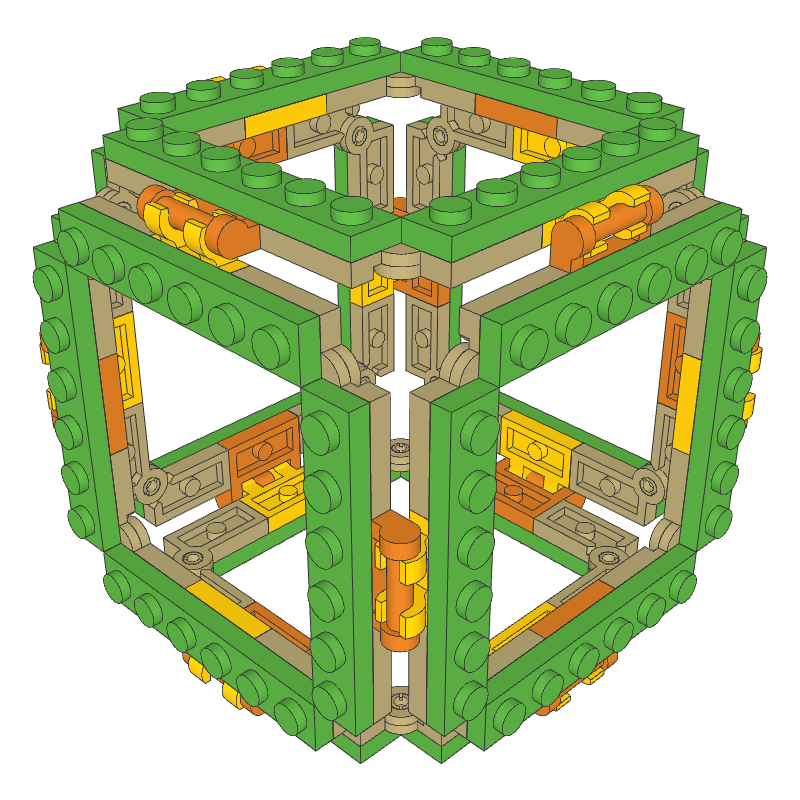
Octahedron, Tetrahedron, Cube
Dead Homer
(2014-11-07,
flickr.com)
For completeness, the remaining Platonic solids
Icosahedron
Dead Homer
(2014-11-07,
flickr.com)
First built in 2000, with the old finger hinges. And then I went crazy a built LOTS of polyhedra.
Dodecahedron
Dead Homer
(2014-11-07,
flickr.com)
Dual to the icosahedron, and therefore built with exactly the same parts
platonische Körper
namenlos
(2026-08-05,
1000steine.de)
anbei “meine” Version der platonischen Körper.
Wobei es diese Bautechnik aber schon gibt.
Generell sind platonische Körper darüber definiert, dass sie größtmögliche Symetrie aufweisen.
The same principle can also be used to create any thinkable shape in 3D space. Here are some more examples:
Rhombic Triacontahedron
Joe Miller
(2015-01-11,
flickr.com)
You may have seen Dead Homer’s version in the Lego Movie.
Although I designed this a long time ago, it is essentially the exact same design
Polyhedral Ornaments
Chamberlain
(2021-07-26,
polyhedonistic.blogspot.com)
For our paper on LEGO polyhedra, I built several truncated octahedron models.
Polyhedral Approximations of the Sphere in LEGO®
Jin Yamauchi & Chamberlain Fong
(2021-01-01,
archive.bridgesmathart.org)
We present our attempts at modeling the sphere using LEGO® parts.
We approach this task by approximating various well-known polyhedral shapes and assessing their resemblance to the sphere.
Instead of plates, the polygons can also be made of other parts – like locking hinge pieces:
Lunar Oasis
Miro Dudas
(2015-07-03,
flickr.com)
Dome is a truncated icosahedron (classic soccer ball pattern of hexagons and pentagons).
Swiss Cheese Dome
Miro Dudas
(2015-11-15,
flickr.com)
Scaled up the brick hinge dome by double the dimensions.
280 brick hinges used to make 20 hexagons and 6 pentagons.